ISO 9001 Certification in Panama: Costs, Timelines and Steps
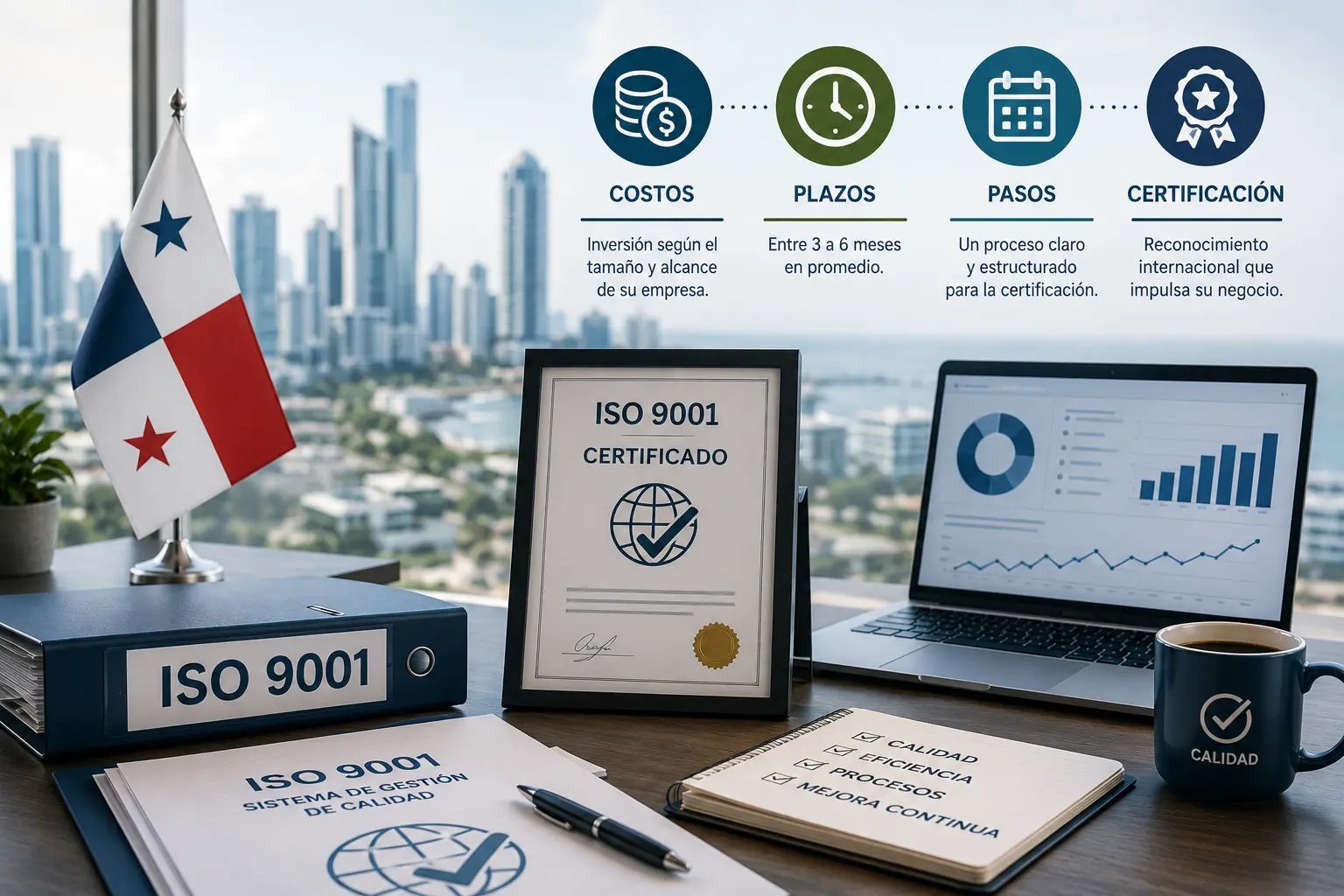
The question almost always arrives in the same order: first how much it costs, then how long it takes and, at the end, once the decision is already made, who signs the paper. That inverted order explains a good share of the certification projects that stall halfway through.
Whoever is asking usually has a deadline: a client demanding it in a tender, a parent company requiring it, a competitor who already has it. And they find that the available information either comes from another country or is a landing page with a form. Let us go step by step, with what applies in Panama.
What exactly gets certified, and what does not
ISO 9001 does not certify a product or a service. It certifies the management system the organization uses to produce them: that processes are defined, that there are owners, that controls operate and that when something fails there is a mechanism to correct it and keep it from happening again.
The distinction is not semantic. It determines the scope, and the scope determines the cost. A company certifying "operations at the Panama headquarters" and one certifying "the entire regional operation" are running two different projects with two different invoices, even though the standard is the same.
The classic mistake is declaring a broad scope so the certificate looks better. It is expensive twice: during implementation and at every surveillance audit over the following three years.
Who issues the certificate in Panama
There are three actors here and they get confused constantly.
The DGNTI, part of the Ministry of Commerce and Industries, is "the national standardization body, which acts in the elaboration, adoption or adaptation of standards in the field of industry, commerce and services". It standardizes. It does not certify companies.
The National Accreditation Council (CNA), also under the MICI, is "the National Accreditation Body of the Republic of Panama" and its function is "to accredit Conformity Assessment Bodies". It accredits those who assess. It does not certify companies either.
The certification body is a private entity that audits your system and issues the certificate. It is the only one of the three that signs your paper.
There is a detail worth knowing before signing with anyone: the accreditation schemes the CNA currently offers are testing and calibration laboratories, inspection bodies, and validation and verification bodies. Management system certification is not among them. In practice, Panamanian companies certify with bodies accredited abroad. That invalidates nothing, but it does explain why quotes vary so much: not every certifier carries the same international backing, and not every client of your client will accept them equally.
Before comparing prices, ask who accredits that certifier. If the answer is vague, keep looking.
How long it takes: the four phases
From zero to certificate, four to eight months for a mid-sized organization with processes already running. The range depends less on size than on two things: how much documentation already exists and how much real availability the team has.
Assessment and scope. You map what exists against what the standard requires. In a regulated company this comes as a surprise: there is usually far more than expected, poorly organized. Weeks 1 to 4.
Design and implementation. Policy, objectives, processes, risk and control matrix, procedures. Process owners take part in the drafting: a procedure written by a third party without the area involved is followed while the project lasts and abandoned afterwards. Weeks 4 to 16.
Internal audit and management review. This is where it is decided whether certification will be a formality or a race against the clock. An internal audit that merely confirms the paperwork is in order is worth nothing. Weeks 16 to 22.
Certification audit. The body audits in two stages: documentation first, then implementation in the field. Between one and the other you have to close findings. Weeks 22 to 32.
When the system was genuinely implemented and the internal audit looked for real problems, most organizations pass on the first audit. When they rushed, they do not.
What the cost depends on
There are two invoices and they come from different issuers. Confusing them is the origin of almost every budget surprise.
The first is consulting: the support to design and implement the system. It depends on the scope, the number of processes, how much documentation exists and how much work the internal team takes on.
The second is the certification body audit. It is quoted in auditor-days, and auditor-days depend on the number of employees within scope and the number of sites. The consultancy does not pay it: the company pays it directly to the certifier.
Maintenance is added to that. The certificate lasts three years, with annual surveillance audits and a recertification at the end of the cycle. A budget covering only the first year is incomplete.
What almost nobody invoices but everybody pays is the internal team's time. It is the largest cost and the most underestimated.
If your company is regulated, start here
For a bank, a credit union or an insurer, this project is framed differently, and in their favour.
Agreement 011-2018 of the Superintendency of Banks establishes that operational risk management must include identification, measurement, mitigation, monitoring and control. ISO 9001 requires a process approach and risk-based thinking. The overlap is enormous.
The practical consequence: the process, risk and control matrix can be a single one, with different views depending on who reads it. Building two parallel systems — one for the regulator and another for the certifier — doubles the cost without adding a single control. It is the most expensive mistake I see in the sector, and the most common.
In the banks where I have worked, the certification project ended up shorter than expected precisely because of this: a good part of the work was already done out of regulatory obligation. What was missing was ordering it under a single structure and filling the gaps the standard asks for and regulation does not.
Checklist: you are ready for the audit if…
- The scope is written and bounded, and every process it includes has a named owner.
- The quality policy and objectives are measurable, not statements of intent.
- A risk and control matrix exists, and somebody reviewed it in the last three months.
- Procedures were drafted or reviewed by the areas that execute them.
- There are records proving the controls operated, not merely that they exist.
- At least one full internal audit was carried out and its findings are closed or have a plan and a date.
- A management review took place, documented, with decisions made.
- The team knows how to answer what they do, where it is written and where the evidence is.
If you fail on point 5 or point 8, the audit will find it.
Common mistakes
Certifying a broad scope so it looks better. Expanding later is straightforward; narrowing a scope already declared to the certifier is not.
Documenting before understanding. It produces manuals nobody recognizes as their own and that do not survive a review.
Appointing a quality manager without authority. If they cannot decide on other areas' processes, they administer documents, not a system.
Treating the internal audit as a formality. It is the only chance to find the problems while there is still room.
Shelving the system after certifying. The certifier comes back. The difference between renewing smoothly and scrambling in the preceding weeks is whether the system was used during the year.
Where to start
If you are evaluating certification, the first step is not requesting quotes: it is defining the scope and knowing what you already have. With those two things, quotes become comparable and the timeline stops being guesswork.
In our quality systems service we work through that assessment first, and the detail of the support up to the certificate is on the ISO 9001 certification page. If your organization is regulated by the SBP, it is worth first reading how it integrates with regulation in ISO 9001 for the financial sector.
Want to know where you stand? Book a free 15-minute assessment and we will review your specific situation.

CEO, Grupo Alternative
Katherine González
PMP® | ISO 9001 Lead Auditor | MBA
I've spent 15 years helping companies in Latin America optimize their processes. I've seen how BPM transforms companies from within—reducing costs, accelerating growth, and improving the quality of life for teams.
Share this article