How to Implement a PMO in 90 Days: A Practical Guide
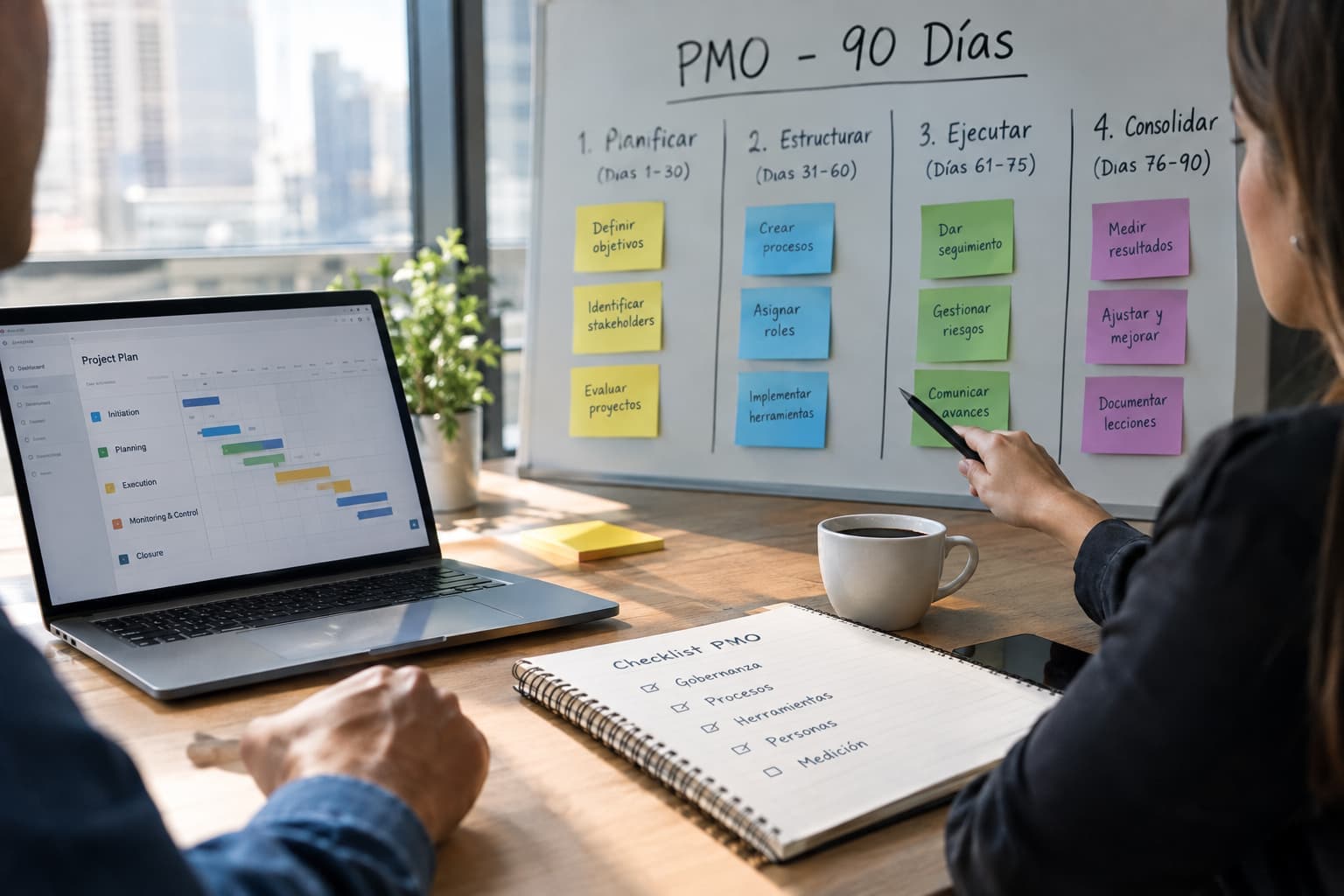
The decision to set up a PMO almost never comes from a strategic plan. It comes from an uncomfortable meeting: somebody asks how many projects are under way and nobody has the same answer.
From there two things usually happen, both bad. Either a tool gets purchased and order is expected to arrive on its own, or an ambitious PMO is designed that in six months has delivered nothing visible and loses the support that created it. Ninety days is enough for a PMO to prove its value, provided you accept what it will not do in that window.
What problem a PMO actually solves
A PMO does not manage projects. Project managers do that. A PMO does three things nobody else does:
It provides visibility. How many projects exist, in what state, consuming which resources. It sounds basic, and it is exactly what is missing in most of the cases I see.
It prioritizes. When two projects compete for the same person, somebody has to decide. Without a PMO that decision is made by whoever shouts loudest.
It standardizes the minimum. A common language for status, risks and progress so reports can be compared with each other.
If your problem is that one specific project is going badly, you do not need a PMO: you need a good PM. A PMO makes sense when the problem is the whole portfolio.
Month 1: inventory and visibility
The first month designs nothing. It counts.
Weeks 1-2. An inventory of everything the organization calls a project. More will surface than expected, and some will not be projects but large tasks or initiatives that never formally started. For each one: name, objective, sponsor, owner, committed date and perceived status.
The most frequent finding of this phase is that several projects share the same objective under different names in different areas.
Weeks 3-4. Real status, which is not reported status. It gets contrasted with whoever executes, not with whoever reports. This is where the projects that have been declared almost finished for months and never close come to light.
At the end of month 1 the PMO delivers one thing: the complete list with its real status. That alone justifies the quarter.
Month 2: minimum governance and prioritization
With the picture on the table, now you decide.
Weeks 5-6. A project committee is defined with a written mandate: what it decides, how often it meets and what information it receives. There is no need to create a new body if one already exists that can take it on.
Weeks 7-8. Portfolio prioritization. The useful exercise is not ranking by importance — everything is important to its sponsor — but answering an uncomfortable question: if we could only execute half, which half?
This is where a PMO earns its place or loses it. Prioritizing means some projects stop, and somebody has to hold that decision in front of their sponsor. Without backing from management this step does not happen and the PMO is reduced to producing reports.
Month 3: method and measurement
Weeks 9-10. The standardized minimum: a project charter template, a status report format and a risk register. Three artefacts, not fifteen. Each one should fit on a page.
The proof that a template is right is that a PM fills it in twenty minutes. If it takes two hours, it will be abandoned by the third week.
Weeks 11-12. First full cycle of reporting and committee. Templates get corrected with what was learned and portfolio indicators are agreed.
By the close of the 90 days the PMO should be able to answer, with data: how many projects exist, which are at risk, which were stopped and why, and what resources are committed.
If the institution is regulated
In banking a PMO has an additional angle worth using from the outset.
Agreement 011-2018 of the Superintendency of Banks requires identifying, measuring, mitigating, monitoring and controlling operational risk. A change to a core process is exactly that kind of event. And Agreement 003-2012, dated 22 May 2012, establishes guidelines for information technology risk management.
Translated: the portfolio risk register is not a PMO artefact, it is regulatory evidence. If it is designed with that in mind from month 1, the PMO stops being an administrative cost and starts solving a requirement the institution already had.
The 90-day checklist
- Complete project inventory, with sponsors and owners named.
- Real status contrasted with whoever executes, not with whoever reports.
- Duplications identified and resolved.
- Project committee with a written mandate and a fixed cadence.
- Prioritized portfolio, with stop decisions made and communicated.
- Three templates at most: charter, status report, risk register.
- One full reporting cycle executed and adjusted.
- Indicators agreed and baseline measured.
If on day 90 you cannot say how many projects were stopped, the PMO did not prioritize: it only documented.
Common mistakes
Starting with the tool. Portfolio software without a defined process produces data nobody maintains. The tool comes in month 4 or later.
Designing the complete PMO before starting. Methodology, templates, roles and maturity levels before having counted the projects. Six months of design and zero value delivered.
A PMO with no authority to stop anything. If it only consolidates reports, it is an administrative function with an elegant name.
Over-standardizing. Fifteen mandatory templates guarantee they get filled in badly or not at all.
Not measuring the baseline. Without the initial state there is no way to prove improvement, and the following year the PMO will have to justify its budget without data.
What does not fit in 90 days
Worth saying up front so as not to over-promise: it does not fit to change the project management culture, nor to roll out a complete methodology, nor to have every PM certified, nor a mature portfolio management system.
What does fit is to stop improvising. And in most organizations, that is the big leap.
Where to start
If you are going to set up a PMO, the prior question is not which model to adopt but who will back it when a project has to be stopped. Without that answer, the rest is cosmetic.
You can see the two arrangements we work with — implementing an internal PMO or bringing in an outsourced director — in PMO, and the wider practice in project management. If the portfolio is not aligned with strategy, it is worth reading the strategic planning checklist first.
Want to check your starting point? Book a free 15-minute assessment.

CEO, Grupo Alternative
Katherine González
PMP® | ISO 9001 Lead Auditor | MBA
I've spent 15 years helping companies in Latin America optimize their processes. I've seen how BPM transforms companies from within—reducing costs, accelerating growth, and improving the quality of life for teams.
Share this article